 how-to
Motorcycle Financing With No Credit Impact: 2026 Guide
Table of Contents
- Does Checking Motorcycle Financing Options Hurt Your Credit?
- How a Motorcycle Loan Soft Credit Check Works
- What Lenders Require for Approval
- Motorcycle Financing Down Payment Requirements Explained
- Pre-Qualification vs Pre-Approval for Motorcycles
- Steps to Improve Your Approval Odds
- Understand the Total Cost Before You Commit
- Get Your Motorcycle Financing Started
- Frequently Asked Questions
Last Updated: September 8, 2026
Many riders assume that checking motorcycle financing options will damage their credit score, so they delay shopping or settle for the first dealer offer. That assumption is often wrong. Motorcycle financing no credit impact is possible when lenders use a soft credit pull to pre-qualify you, which does not affect your score at all. At Monarch Powersports, we use 700Credit technology to deliver instant credit decisions through a secure, high-encryption process designed to protect your credit profile.
A soft credit check is a common tool lenders use to evaluate your financial standing without leaving a trace on your report. This guide from Monarch Powersports explains the difference between a soft pull and a hard inquiry, so you can shop with confidence.
Does Checking Motorcycle Financing Options Hurt Your Credit?
Checking motorcycle financing options does not hurt your credit when the lender performs a soft credit pull. A soft inquiry allows a lender to review your creditworthiness without impacting your score or appearing on your credit report for other lenders to see. This is the standard method for pre-qualification and instant credit decisions.
Hard inquiries tell a different story. A hard inquiry occurs when you formally apply for credit and the lender requests your full credit report to make a final approval decision. Each hard inquiry can lower your score by a few points and remains visible on your report for up to two years (consumer.ftc.gov). The key distinction is that pre-qualification uses a soft pull, while the final loan application typically requires a hard inquiry.
How a Motorcycle Loan Soft Credit Check Works
A motorcycle loan soft credit check works by giving the lender a limited view of your credit history without adding an inquiry to your report. It typically reveals your credit score, outstanding balances, and payment history, but does not count against you. Lenders use this information to provide a preliminary rate quote and loan amount.
The process moves quickly. After you submit basic information, the lender runs the soft pull through a system like 700Credit and returns an instant decision. Because no hard inquiry is generated, you can check rates with multiple lenders and compare offers without cumulative damage to your score.
What Lenders Require for Approval
Lenders require proof of income, a valid government-issued ID, proof of residence, and a reasonable credit history for motorcycle loan approval. Even buyers with limited credit history can qualify when they meet these core requirements and demonstrate financial stability.
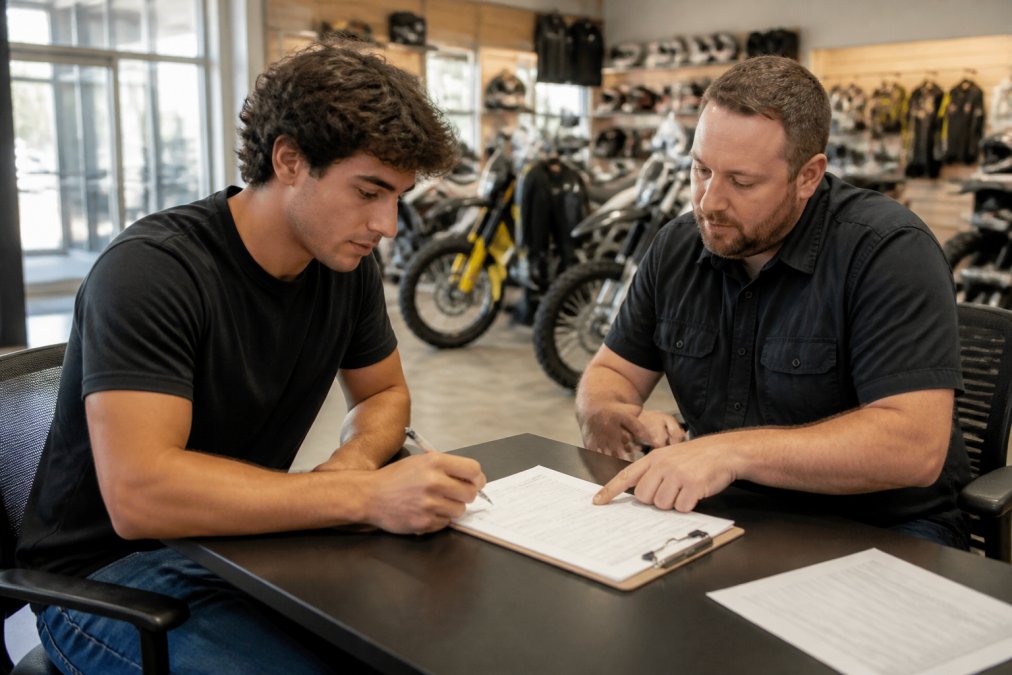
The specific documents you should bring include:
- Recent pay stubs or bank statements showing consistent income
- A driver's license or state-issued ID
- Proof of residence, such as a utility bill or lease agreement
- References or additional contact information, if requested
Lenders weigh your debt-to-income ratio heavily. This ratio compares your monthly debt payments to your gross monthly income. A lower ratio signals you can handle an additional installment loan, while a higher ratio may require a larger down payment or a co-signer.
Motorcycle Financing Down Payment Requirements Explained
Motorcycle financing down payment requirements typically range from 10 to 20 percent of the purchase price for buyers with good credit, but subprime borrowers may need more. A larger down payment reduces the lender's risk, often resulting in a lower interest rate and better loan terms.
Your down payment serves as immediate equity in the motorcycle. If you finance a $10,000 bike with a 20 percent down payment, you start with $2,000 in equity, protecting the lender if the motorcycle depreciates faster than the loan balance decreases.
For buyers with limited credit history or past credit challenges, planning a down payment closer to 20 or 25 percent improves approval odds substantially. Some lenders offer first-time buyer programs with more flexible down payment structures.
Why the Down Payment Matters More When You Have No Credit
When you have no credit history, the down payment is your primary signal of commitment to the lender. A larger down payment reduces the lender's exposure if you default, which is why subprime lenders often require 20 to 30 percent down while prime borrowers might get away with 10 percent. This is not a penalty, it is risk pricing.
The Depreciation Trap: Why 20 Percent Is a Floor, Not a Target
Motorcycles depreciate faster than cars. A new bike can lose 15 to 25 percent of its value in the first year alone, and after three years, many models retain only 60 to 70 percent of their original MSRP (kbb.com). If you put only 10 percent down, you are immediately upside down, owing more than the bike is worth, the moment you ride off the lot.
A 20 percent down payment on a $10,000 bike gives you $2,000 in equity, but given first-year depreciation of roughly $1,500 to $2,500 on a typical new model, that cushion is thin. A 25 percent down payment, $2,500, provides a more realistic buffer.
How to Build Your Down Payment Fund
If you are starting from zero, set a savings target based on the bike you want, not the payment you hope to afford:
- Set a bike budget first. Decide on a maximum out-the-door price, including taxes and dealer fees. For a $8,000 bike, a 20 percent down payment is $1,600. For a $12,000 bike, it is $2,400.
- Open a separate savings account. Keeping the down payment fund separate from your checking account prevents accidental spending.
- Automate weekly transfers. Even $50 per week adds up to $2,600 in a year. If you can save $100 per week, you will hit a $2,400 target in six months.
- Delay the purchase by one season. Buying in late fall or winter often yields better deals on previous-year models, and the extra months give you time to save.
The Trade-Off: Bigger Down Payment vs. Keeping Cash Reserves
A larger down payment improves your loan terms, but it is not always the right move. If it depletes your emergency fund, you are trading financial security for a slightly lower interest rate. A common pattern among first-time buyers is to put 20 percent down and keep an additional $1,000 to $1,500 in reserve for gear, insurance, and unexpected repairs.
How Down Payment Affects Your Interest Rate
Lenders use loan-to-value (LTV) ratio to price risk. A lower LTV, meaning a larger down payment, often qualifies you for a lower rate tier. For example, a lender might offer a 12 percent APR with 10 percent down but drop to 10 percent with 20 percent down. On a $8,000 loan over 36 months, that 2 percentage point difference saves you roughly $250 in interest. interest-free payment plans.
If you have no credit, the rate difference between down payment tiers can be even more pronounced. Some subprime lenders reserve their best rates for borrowers who put 25 percent or more down. Ask your lender or dealer for the rate sheet showing how APR changes at different down payment levels.
Pre-Qualification vs Pre-Approval for Motorcycles
Pre-qualification is a preliminary review based on self-reported information and a soft credit check, while pre-approval is a more rigorous verification that may involve a hard inquiry. For motorcycle financing no credit impact, pre-qualification is the stage you want to use while comparing options.
Here is how the two stages compare:
| Stage | Credit Check | Information Verified | Impact on Score |
|---|---|---|---|
| Pre-qualification | Soft pull | Self-reported income, basic credit review | None |
| Pre-approval | Soft pull or hard inquiry | Income verification, employment, full credit review | Possible hard inquiry |
| Final loan application | Hard inquiry | Complete verification | Small, temporary dip |
Most riders should start with pre-qualification to understand their rate range and monthly payment estimates. Once you have selected a motorcycle and are ready to purchase, move to the formal application, where a hard inquiry is expected and acceptable.
Steps to Improve Your Approval Odds
Improving your approval odds for motorcycle financing starts with reviewing your credit report for errors and addressing any outstanding balances before you apply. A clean report gives lenders confidence and can improve the rate you receive.
Follow these steps to strengthen your application:
- Pull your credit report from the major bureaus and dispute any inaccuracies you find
- Pay down revolving credit card balances to lower your debt-to-income ratio
- Avoid opening new credit accounts in the months before your application
- Save for a down payment of at least 20 percent
- Consider a co-signer with strong credit if your history is thin
A co-signer with established credit reduces the lender's risk substantially, which can lead to a lower interest rate. Just remember that the co-signer is equally responsible for the loan, so choose someone you trust.
Understand the Total Cost Before You Commit
The total cost of motorcycle ownership extends far beyond the monthly payment. Beyond the loan principal and interest, you must budget for insurance, safety gear, registration, and ongoing maintenance.
Motorcycle insurance is not optional in most states, and premiums vary based on the bike's power, your riding history, and your location (iii.org). Get quotes before you commit to a specific bike so the premium does not surprise you after the sale.
Safety gear adds another layer of cost that many first-time buyers underestimate. A quality helmet, riding jacket, gloves, and boots can easily add hundreds of dollars to your initial investment.
Get Your Motorcycle Financing Started
Motorcycle financing no credit impact is achievable when you understand the process and work with the right lender. Pre-qualification through a soft credit check lets you explore your options freely, and a proper down payment combined with a clean credit profile positions you for favorable terms.
Financing a Private Party Purchase: The Underserved Path
Most financing guides assume you are buying from a dealership, but a significant portion of motorcycle purchases happen between private parties. If you are buying a used bike from an individual seller, the financing process is different, and often harder.
Dealerships have relationships with lenders; private sellers do not. When you buy from a dealer, the dealer submits your application to multiple lenders and handles the paperwork. When you buy from a private seller, you must secure your own financing before you hand over the cash.
Credit unions are the most private-party-friendly lenders. Many offer used motorcycle loans that work for private sales, provided the bike meets their age and mileage requirements. A common policy is to finance bikes up to 10 years old with fewer than 30,000 miles, though this varies. Credit unions typically require membership, often meaning opening a savings account with a small deposit, usually $5 to $25, and waiting a few days for activation.
Online lenders and banks are less flexible. Most national banks do not offer motorcycle loans at all, and the online lenders that do often restrict loans to dealership purchases. If you find one that allows private party purchases, read the fine print, some require the seller to be a licensed dealer.
How to Structure a Private Party Financing Deal
- Get pre-approved before you negotiate. Use a soft-pull pre-qualification to understand your rate and loan amount. This protects your credit and gives you a firm budget.
- Verify the title before you commit. Ask the seller for the VIN and run a title check through NMVTIS. This confirms the bike is not stolen and has no outstanding liens.
- Have the bike inspected. A pre-purchase inspection by an independent mechanic costs $100 to $200 and can save you from buying a bike with hidden damage. Lenders will not require this, but you should.
- Complete a bill of sale. Both parties should sign a bill of sale that includes the VIN, purchase price, and odometer reading. Your lender will provide the specific form they require.
- Handle the title transfer properly. The seller must sign the title over to you, and you must file the transfer with your state's DMV within the required timeframe, typically 10 to 30 days. Your lender will hold the title as collateral until the loan is paid off.
The Trade-Off: Private Party vs. Dealer Financing
Private party purchases often save you money on the purchase price, you avoid dealer markup and documentation fees, but the financing terms may be less favorable. Dealers can sometimes secure promotional rates from manufacturer-backed lenders, especially on new bikes.
For buyers with no credit, a dealer may be the easier path because the dealer's finance team can shop your application across multiple lenders. A credit union, by contrast, will evaluate your application against their single set of criteria.
Your Next Steps, Regardless of Purchase Path
- Get pre-qualified with a soft pull. This gives you your rate range and loan amount without impacting your credit.
- Compare at least three lenders. Check a credit union, an online lender, and a dealer's financing desk. Rates vary significantly, and the difference between a 10 percent APR and a 15 percent APR on a $8,000 loan over 36 months is about $600 in interest.
- Decide on your down payment. Use the 20 percent guideline, but adjust based on your cash reserves and the bike's expected depreciation.
- Get insurance quotes before you buy. Your premium depends on the bike's power, your riding history, and your location. A quote takes five minutes and prevents a post-purchase surprise.
- Budget for gear. A quality helmet, jacket, gloves, and boots add $500 to $1,000 to your upfront costs. Factor this into your total budget.
Frequently Asked Questions
Can I finance a motorcycle with no credit score?
Yes. Lenders use other signals when you have limited credit history. A steady job, proof of income, and a larger down payment all reduce their risk. Some first-time buyer programs exist specifically for this situation. Expect a higher APR than someone with an established score. Your application goes through a soft credit pull first, so checking your options will not damage your score. A co-signer with good credit can also strengthen your application.
Does checking motorcycle loan rates affect my credit score?
No, not when you use a soft credit check. Monarch Powersports uses 700Credit technology to run a soft pull, which gives you an instant decision without a hard inquiry. A hard inquiry only happens after you accept the loan terms and finalize the paperwork. Multiple hard inquiries in a short period can lower your score by a few points. Always confirm which type of pull the lender runs before you apply.
How much down payment is needed for a motorcycle with poor credit?
Expect to put down more than a buyer with good credit. Many lenders ask for 10-20% of the purchase price. With poor credit or no score, that number can climb to 20-30% or more. A larger down payment reduces the loan amount and shows the lender you have skin in the game. It also lowers your monthly payment and total interest paid over the loan term.