 comparison
Is Electric Motorcycle Riding Different? A 2026 Guide
Table of Contents
- How Electric Motorcycle Riding Feels Different From the First Twist
- Electric Motorcycle vs Gas Motorcycle Performance: Torque, Speed, and Power Delivery
- No Clutch, No Gears: How the Ride Changes
- Braking, Weight, and Cornering Dynamics
- The Best Electric Motorcycle for Track Riding
- Maintenance, Range, and Ownership Differences
- Conclusion
- Frequently Asked Questions
Last Updated: September 14, 2026
How Electric Motorcycle Riding Feels Different From the First Twist
Electric motorcycle riding means operating a two-wheeled vehicle powered entirely by an electric drivetrain, and it differs from gas riding most noticeably in how power reaches the rear wheel. Twist the throttle on a gas bike and you wait for revs to build; on an electric bike the torque arrives immediately.
The first thing most riders notice is silence: without an engine, you hear tire noise, wind, and motor whine, and the audio cue you have relied on for years is gone. The second is the launch, peak torque from zero rpm, so acceleration feels instant rather than building through the rev range.
Here is a quick snapshot of what changes:
| What Changes | Gas Motorcycle | Electric Motorcycle |
|---|---|---|
| Power delivery | Builds with rpm | Instant from zero rpm |
| Transmission | Clutch and gears | Single-speed, no clutch |
| Sound | Engine exhaust note | Motor whine and wind |
| Braking feel | Engine braking | Regenerative braking |
| Refueling | Gas station | Home or public charging |
Electric Motorcycle vs Gas Motorcycle Performance: Torque, Speed, and Power Delivery
The core performance difference is torque delivery. A gas engine needs to reach a certain rpm before it makes its best power, which is why you downshift to pass. An electric motor makes maximum torque the moment it starts turning, so roll-on acceleration is immediate at any speed within its range.
Instant Torque and Acceleration
Instant torque defines an electric drivetrain. With no combustion cycle to build and no gear to select, the motor's full twisting force is available the instant you open the throttle, so acceleration feels linear and predictable rather than peaky. For a commuter, that means confident merging; for a track rider, picking up the throttle mid-corner without waiting for revs.
Top Speed and Sustained Power
Top speed is where gas bikes often retain an edge. Many electric motorcycles are electronically limited, and sustained high-speed running drains battery capacity quickly, shortening range. A gas bike can hold highway speed for hours; an electric bike may need to manage thermal and battery limits on a long, fast run. For most street and track use, the difference is smaller than the spec sheet suggests.
No Clutch, No Gears: How the Ride Changes
Riding without a clutch or gearbox surprises experienced riders most. Almost every electric motorcycle uses a single-speed transmission: no lever to feather, no shift pattern to learn, no risk of stalling. You open the throttle and go.
That simplicity has real consequences. In stop-and-go traffic you no longer work a clutch for an hour, and on a hill start you cannot roll backward because there is no neutral to slip into. The trade-off is losing the engine-braking control many riders use to set corner speed; regenerative braking takes over instead, slowing the bike as it recovers energy. Some riders love it, others miss the mechanical connection, the biggest reason to test ride before buying.
Braking, Weight, and Cornering Dynamics
Most comparisons stop at the spec sheet. The real difference shows up in the first hard corner and the first hard stop, and it comes down to three things: where the mass sits, how the brakes blend, and how torque reaches the rear tire.
Where the Weight Actually Sits
A battery pack is dense, roughly 100 to 160 Wh/kg at the pack level for current lithium-ion chemistries, and it is mounted low and central, often where a gas engine and fuel tank would be, dropping the center of gravity well below a comparable gas bike's (FOTW #1234, April 18, 2022). The effects:
- Turn-in feels heavier, then lighter. The bike resists the initial flick because curb weight is higher, but once leaned it feels planted and refuses to stand up mid-corner.
- Side-to-side transitions cost more effort. A chicane or tight slalom rewards smooth, deliberate steering rather than quick flicks.
- Low-speed maneuvering is the tell. Walking pace in a parking lot is where the extra mass is most obvious. Practice figure-eights before riding in traffic.
A typical middleweight electric motorcycle weighs 400-550 lb, comparable to or slightly above a 600cc sportbike. The difference is not the number, it is where the number lives.
How Regenerative and Friction Braking Blend
On an electric bike, the rear wheel does two jobs at once: slowing the bike and feeding energy back to the pack. Most systems blend them like this:
- Closed throttle engages light regeneration. The motor becomes a generator, and the drag you feel is the motor resisting rotation.
- Light brake lever pressure increases regeneration before the friction pads bite. On many bikes you can ride an entire commute without touching the discs.
- Hard lever pressure brings in the hydraulic calipers. The transition point is where feel gets tricky, some bikes hand off smoothly, others have a noticeable step.
Two things follow. First, regeneration only works on the wheel it is connected to, usually the rear, so front-brake feel is unchanged. Second, regeneration fades as the battery fills, a fully charged pack cannot absorb more energy, so the drag disappears and you rely entirely on friction brakes. Riders who charge to 100% before a long descent are often surprised.
Cornering: Why Throttle Control Matters More
On a gas bike, you exit a corner by rolling on throttle as revs build, a naturally progressive input. On an electric bike, full torque is available the instant you ask for it, so a careless wrist can spin the rear or upset the chassis mid-corner. The fix is not to ride slower; it is to ride smoother:
- Pick your throttle earlier and apply it more gradually. The motor rewards a long, linear roll-on.
- Use regeneration as a corner-entry tool. Where you would downshift and use engine braking on a gas bike, dial in regen to set entry speed without touching the brakes.
- Trust the low center of gravity on exit. The bike holds a line under power better than its weight suggests, provided your input is smooth.
Suspension Setup Is Not Optional
Because the mass is concentrated and the torque is instant, suspension setup matters more on an electric bike than on a comparable gas machine. Sag, compression, and rebound need to be set for your weight and pace: a bike set up for a 160 lb rider feels harsh and nervous under a 220 lb rider, and the reverse feels wallowy. Most dealers will set sag at delivery. Ask for it.
The Best Electric Motorcycle for Track Riding
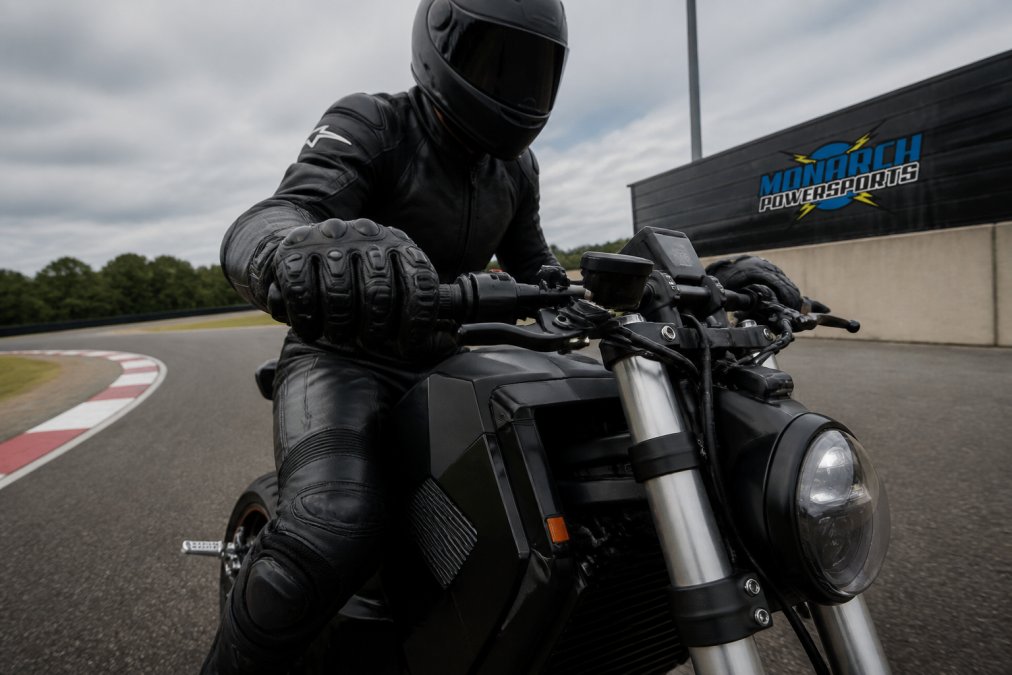
The best electric motorcycle for track riding is built around a stiff chassis, a low center of gravity, and a motor that delivers torque predictably rather than in a sudden spike. Track use exposes weaknesses street riding hides: heat management, brake fade, and behavior under full power lap after lap.
When you evaluate a track-focused electric bike, look for these traits:
- A chassis designed for the loads of circuit riding, not adapted from a commuter platform
- Consistent power delivery across a full session, not just the first few laps
- A braking system that blends regeneration and friction without a mushy transition
- Suspension that is adjustable, so it can be dialed in to your weight and pace
- A battery and thermal system that hold up under repeated hard acceleration
Calibration matters as much as hardware. A bike set up for a lighter rider feels nervous and over-reactive for a heavier one, and vice versa. Professional setup, suspension sag and throttle mapping adjusted to the rider, changes how a track bike behaves more than most riders expect.
Maintenance, Range, and Ownership Differences
Ownership is where the electric-versus-gas decision gets made. Here is the concrete version.
What You Stop Paying For, and What You Still Do
An electric motorcycle eliminates combustion-related service items entirely:
- No oil changes, oil filters, or spark plugs
- No air filter, fuel filter, or fuel injectors
- No valve adjustments or timing service
- No clutch plates, clutch cable, or transmission fluid
- No chain to clean and lubricate if the bike runs a belt or direct drive
What remains is the same as any motorcycle: tires, brake pads and fluid, suspension service, wheel bearings, and, on belt-drive bikes, belt inspection and eventual replacement. Brake pads often last longer because regeneration does much of the slowing, but they still wear and need checking.
The net effect is fewer service visits and lower routine cost, but not zero maintenance. Budget for tires and brakes like any bike.
Real-World Range: Why the Spec Sheet Lies
Manufacturer range figures are measured under ideal conditions. Real range depends on four variables, in roughly this order:
- Speed. Aerodynamic drag rises with the square of speed. Sustained 70 mph highway running can cut range by 30-40% versus a steady 35 mph commute (All-Electric Vehicles).
- Temperature. Cold reduces usable battery capacity and increases internal resistance. Expect meaningful range loss below about 50°F (energy.gov).
- Throttle behavior. Hard acceleration from every stop draws heavily. Smooth riding extends range noticeably.
- Terrain and payload. Hills and a loaded top case both cost range.
A practical rule: take the manufacturer's city range figure and cut it by a third for mixed highway use, and by half for cold-weather highway use. Plan around that number.
Charging: Time Depends on the Outlet, Not the Bike
The biggest variable in charging time is what you plug into, not the motorcycle:
| Source | Typical Output | What It Means |
|---|---|---|
| Standard 120V household outlet | ~1.4 kW | Overnight charge; roughly 8-12 hours for a full pack |
| 240V home or public Level 2 | ~6-7 kW | Two to four hours for a full pack |
| DC fast charger (where supported) | 20 kW and up | Under an hour to 80%, but not all bikes accept DC fast charging |
Check whether the bike you are considering supports DC fast charging before assuming it does. Many commuter-focused models do not, which changes how you plan longer rides.
Insurance and Liability: The Nuances Most Guides Skip
Electric motorcycles are titled and registered as motorcycles, so they generally require the same license endorsement, registration, and minimum liability coverage as a gas bike. Three nuances matter:
- Premium calculation. Insurers rate on displacement, value, and rider record. An electric bike has no displacement, so carriers often rate on motor output (kW) or purchase price instead. A high-output electric can land in a higher premium tier than its sticker price suggests.
- Battery coverage. Confirm whether your policy covers battery damage from a crash, a charging fault, or a thermal event. Some standard motorcycle policies treat the pack as part of the vehicle; others may not. Ask specifically.
- Accessory and gear coverage. Aftermarket chargers, home charging equipment, and riding gear are often covered only if you add them.
Get the VIN-specific quote before you sign. A generic online estimate for 'electric motorcycle' is not a quote.
Parking, Theft, and Daily Practicality
Two ownership realities rarely make it into comparison articles:
- Parking. Electric bikes are often quieter and narrower, which helps in tight urban parking, but they are also targets because of their value. A disc lock and a GPS tracker are cheap insurance against a very expensive loss.
- Theft risk. High-value, easily resold components, battery packs especially, make electric motorcycles attractive to thieves. Lock the bike to something fixed when you can, and park in well-lit, camera-covered areas.
- Home charging setup. If you rent, confirm your lease allows running a cord to a garage or driveway outlet. If you own, a 240V outlet in the garage is the single best upgrade for daily usability.
Conclusion
Electric motorcycle riding rewards riders who adapt: to instant torque, to silent speed, to a single gear. The riders who struggle expect it to feel exactly like a gas bike. To know whether it is right for you, the only honest answer comes from a test ride.
That is what Monarch Powersports is built for. As an authorized partner for Stark Future, Zero Motorcycles, and Husqvarna, we offer private circuit demo sessions so you can feel the torque and handling firsthand. Our certified technicians calibrate each motorcycle to your specifications, and our financing process uses secure 700Credit technology. Schedule a test ride with Monarch Powersports and find out how an electric motorcycle actually feels.
Frequently Asked Questions
Is riding an electric motorcycle different from riding a gas bike?
Yes, the biggest difference is power delivery. Electric motorcycles produce instant torque from a standstill, so acceleration feels immediate with no clutch or gear shifting. You also get regenerative braking that slows the bike when you release the throttle. The silence changes your awareness of speed, and the lower center of gravity affects how the bike leans into corners compared to a gas motorcycle.
Do electric motorcycles have gears and a clutch?
Most electric motorcycles do not have a traditional gearbox or clutch. You twist the throttle and go, which makes them easier to ride for beginners and reduces fatigue in stop-and-go traffic. Some track-focused models use a single-speed reduction drive, but you never shift manually. This means you focus entirely on braking, body position, and throttle control instead of managing gears.
How does the instant torque of an electric motor change the riding experience?
Instant torque means full power is available the moment you twist the throttle, with no waiting for RPMs to build. On a gas bike, you downshift and rev to find the power band. On an electric motorcycle, acceleration is seamless and predictable, which can feel intense at first. It also makes corner exits faster because you can apply power earlier without upsetting the chassis.
Are electric motorcycles easier to ride for beginners?
They can be easier in some ways and harder in others. No clutch or gears simplifies low-speed control, and the lack of engine noise reduces intimidation. However, the instant torque demands smooth throttle input because the bike responds immediately. Beginners should practice in a controlled environment, like a private circuit demo, to get comfortable with the power delivery before riding in traffic.