 ultimate-guide
Choosing Between Electric and Gas Motorcycles in 2026
Table of Contents
- Performance: Gas vs Electric Motorcycle Performance
- Upfront Costs and Incentives
- Electric Motorcycle Maintenance Costs
- Motorcycle Charging Infrastructure and Refueling
- Environmental Impact and Efficiency
- Hybrid and Dual-Fuel Systems: The Best of Both?
- Making the Right Choice for Your Riding Style
- Frequently Asked Questions
Last Updated: September 24, 2026
Performance: Gas vs Electric Motorcycle Performance
The short answer: electric motorcycles win on instant torque and acceleration, while gas motorcycles still lead on sustained high-speed range and track endurance. This guide from Monarch Powersports breaks down the real-world tradeoffs of choosing between electric and gas so you can match a bike to how you actually ride.
Here's what most buyers miss. Peak horsepower numbers tell you almost nothing about which bike feels faster in the first 50 feet. Electric motors deliver full torque from zero RPM, so a mid-tier electric can outrun a bigger gas bike off the line. Gas engines need to build revs before they make real power.
That difference shapes everything else: cost, maintenance, infrastructure, and long-term satisfaction. Below, we'll walk through each factor with the same criteria our technicians use during private circuit demo sessions.
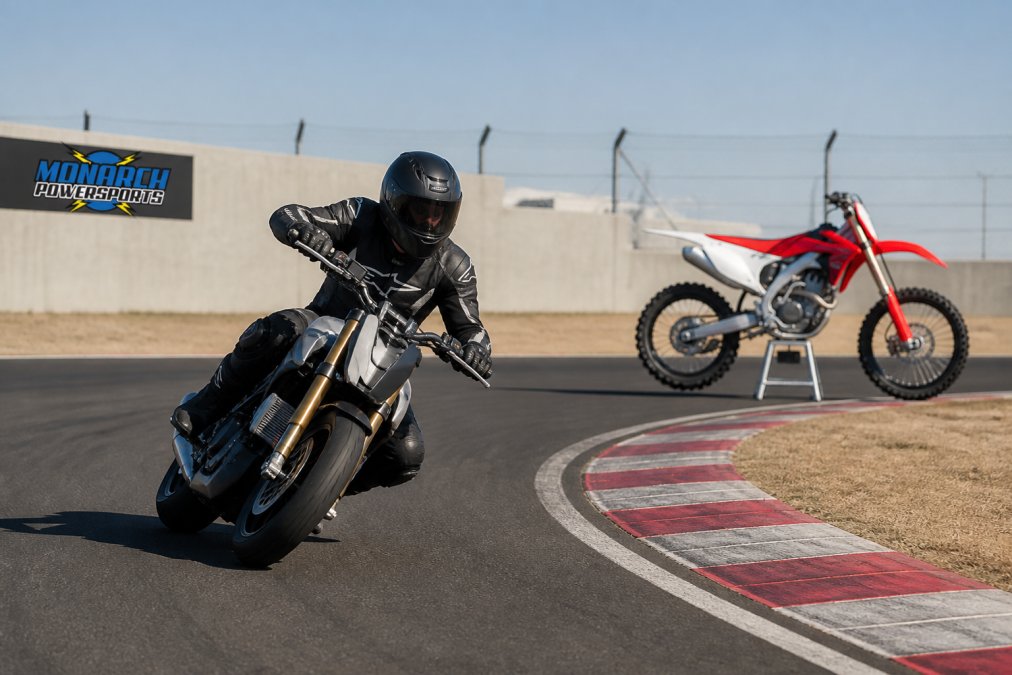
Gas vs electric motorcycle performance comes down to two different power curves:
- Electric: instant torque, single-speed transmission, near-silent operation, strong acceleration from a standstill
- Gas: peak power higher in the rev range, multi-gear engagement, audible exhaust note, sustained output on long runs
| Metric | Electric | Gas |
|---|---|---|
| Torque delivery | Immediate, from 0 RPM | Builds with RPM |
| Acceleration | Quick off the line | Strong once revved |
| Top-speed endurance | Drops as battery depletes | Consistent while fueled |
| Transmission | Single-speed | 5-6 speed manual |
| Noise | Near-silent | Engine note |
The takeaway: pick electric for stoplight-to-stoplight punch and low noise. Pick gas if you ride long highway stretches at sustained speed.
Upfront Costs and Incentives
Electric motorcycles typically carry a higher sticker price than comparable gas models, but the gap narrows once federal and state incentives apply. The sticker gap is real: a mid-tier electric commuter often lists several thousand dollars above a comparable gas bike, while premium electric sport models can run well past the price of a flagship gas liter bike. Pricing at Monarch Powersports depends on the specific model, configuration, and financing terms, so reach out for a current quote rather than relying on a generic figure.
What most buyers miss is that the upfront number is only the first line of the ledger.
A few cost realities worth knowing before you commit:
- Electric models often qualify for federal and state tax credits, but eligibility rules change and vary by state. Check the U.S. Department of Energy incentive database for the current list.
- Gas bikes carry lower purchase prices but higher ongoing fuel and service costs.
- Insurance premiums differ by model, horsepower class, and rider history, not just powertrain. Some carriers still price electric bikes with a surcharge because repair networks and battery replacement costs are less predictable.
- Sales tax, registration, and dealer documentation fees apply to both, but some states offer reduced registration for electric vehicles.
| Cost category | Electric | Gas |
|---|---|---|
| Purchase price | Higher | Lower |
| Federal/state incentives | Often applies | Rarely applies |
| Fuel/energy per mile | Lower and more stable | Higher and volatile |
| Scheduled maintenance | Minimal | Recurring |
| Battery replacement (out years) | Possible major expense | N/A |
| Resale value | Uncertain, model-dependent | Established |
Financing terms also change the effective upfront cost. A longer loan on a higher-priced electric bike can produce a lower monthly payment than a shorter loan on a cheaper gas bike, which is why comparing monthly payments alone is misleading. Compare total interest paid over the life of the loan, not just the payment.
U.S. Department of Energy on electric vehicle tax credits
Electric Motorcycle Maintenance Costs
Electric motorcycle maintenance costs are consistently lower than gas because there is no oil, no filter, no spark plugs, and no valve adjustments. Fewer moving parts means fewer service intervals.
What you still pay for on an electric bike:
- Tires and brake pads (same as gas)
- Battery health checks
- Software updates and firmware service
- Occasional coolant or drive-belt inspection on some models
| Service | Electric | Gas |
|---|---|---|
| Oil changes | None | Every few thousand miles |
| Valve adjustments | None | Periodic |
| Chain/belt care | Minimal | Regular |
| Brake fluid | Yes | Yes |
| Battery service | Periodic check | N/A |
Motorcycle Charging Infrastructure and Refueling
What to plan for:
- Home charging: a standard 120V outlet works for overnight top-ups on most electric models; a 240V setup charges much faster
- Public charging: availability varies widely by region and by connector standard
- Refueling time: gas takes minutes; electric DC fast charging takes considerably longer, and Level 1/2 charging takes hours
Regional energy grid reliability matters here too. Areas with frequent outages or weak infrastructure make home charging less dependable, which is a real argument for keeping a gas bike as your primary.
Environmental Impact and Efficiency
Electric motorcycles produce zero tailpipe emissions, which is the headline environmental advantage. The full carbon footprint depends on how your regional grid generates power. In areas with heavy renewable energy, the lifecycle emissions are dramatically lower. In coal-heavy grids, the advantage shrinks.
The honest comparison:
- Electric: zero direct emissions, efficiency improves as the grid adds renewables, battery production carries an upfront footprint
- Gas: direct emissions every mile, mature and predictable, no grid dependency
Hybrid and Dual-Fuel Systems: The Best of Both?
Most guides frame this as a binary choice. It is not. There are three practical ways to combine electric and gas, and only one of them requires buying a hybrid motorcycle.
What hybrids offer in theory:
- Electric assist for low-speed torque and efficiency
- Gas engine for extended range and refueling speed
- Reduced range anxiety on long trips
What they cost in practice:
- Added weight and mechanical complexity
- Higher purchase price than either pure option
- Limited model availability in the two-wheel market
- Two systems to maintain instead of one
Making the Right Choice for Your Riding Style
The right call depends on how, where, and how far you ride. Use this decision framework:
- Short daily commutes, home charging available: electric wins on cost, maintenance, and instant torque
- Long highway touring, remote routes: gas wins on range and refueling speed
- Mixed use, one bike only: gas remains the safer all-rounder for now
- Performance-first, track-focused: test both. Torque delivery is a personal preference you cannot judge from a spec sheet
U.S. Department of Energy on electric vehicle charging
Frequently Asked Questions
What are the primary performance differences between electric and gas motorcycles?
Electric motorcycles deliver instant torque, providing rapid acceleration from a standstill, while gas motorcycles often have higher top speeds and sustained power for track riding. Your choice depends on whether you prioritize quick acceleration or extended high-speed capability.
How does maintenance compare between electric and combustion engines?
Electric motorcycles have fewer moving parts, so maintenance typically involves battery checks, software updates, and tire care, with no oil changes or spark plugs. Gas motorcycles require regular oil changes, valve adjustments, and exhaust system upkeep. Over time, electric motorcycle maintenance costs can be lower, but battery replacement may be a significant expense after several years.
Is it cheaper to operate an electric motorcycle over time?
Electric motorcycles generally cost less per mile to operate because electricity is cheaper than gasoline, and they have fewer maintenance needs. However, the upfront purchase price is often higher. Long-term savings depend on your annual mileage, local utility rates, and available incentives. Many riders find that the lower operating costs offset the initial investment within a few years.
What should I consider regarding charging infrastructure versus fuel availability?
Gas stations are ubiquitous, making refueling quick and convenient for long trips. Electric motorcycle charging infrastructure is growing but may be limited in rural areas. Home charging is a major advantage, allowing you to plug in overnight. Consider your typical routes and whether you have access to reliable charging before choosing electric.
Which platform offers a better experience for track riding?
Gas motorcycles often excel on tracks due to their high-revving engines, quick refueling, and established racing support. Electric motorcycles provide instant torque and smooth power delivery, which can be advantageous on tight circuits. Some track organizations now have electric classes. Your preference for sound, shifting, and maintenance will influence which feels better.
Do electric motorcycles provide the same torque as gas models?
Electric motorcycles typically produce maximum torque from zero RPM, resulting in stronger low-end acceleration than most gas models. Gas engines need to rev up to reach peak torque. This makes electric bikes feel quicker off the line, but gas bikes may have more torque at higher speeds for passing or track straights.