 listicle
Best Husqvarna Performance Upgrades: 7 Proven Mods
Table of Contents
- Best Husqvarna Performance Upgrades at a Glance
- Muffler Mod and Exhaust Flow: The First Step
- Aftermarket Motorcycle Exhaust Benefits: Beyond Noise
- Base Gasket Delete and Cylinder Work for Compression
- Big Bore Kits and Pop-Up Pistons: Displacement Gains
- Husqvarna ECU Tuning Guide: Fuel and Timing Maps
- Air Filtration and Carburetor Tuning: Engine Breathing
- Professional Motorcycle Suspension Tuning for the Chassis
- Choosing Your Upgrade Path
- Frequently Asked Questions
Last Updated: September 7, 2026
Best Husqvarna Performance Upgrades at a Glance
When you are chasing serious saw power, the best Husqvarna performance upgrades focus on one thing first: letting the engine breathe. Every two-stroke engine is a pump, and restricting the intake or exhaust strangles the torque output and RPM limits that the cylinder is capable of producing. Before you spend money on big bore kits or pop-up pistons, the exhaust and air filtration systems deliver the most noticeable gains for the least effort.
At Monarch Powersports, we have watched riders transform stock machines into race-ready tools. The most effective builds follow a logical sequence: improve engine breathing, then raise compression, then tune the fuel mixture. Skipping that order leads to lean conditions, overheated cylinders, and shortened engine longevity. This guide breaks down the seven proven modifications that deliver real cutting speed and throttle response without turning your saw into a paperweight.
Quick Picks:
- Best First Mod: Muffler modification for increased exhaust flow and lower operating temperatures
- Best Compression Gain: Base gasket delete to raise the compression ratio and sharpen throttle response
- Best Displacement Upgrade: Big bore cylinder kits paired with a pop-up piston for substantial torque gains
Muffler Mod and Exhaust Flow: The First Step
The muffler mod is the highest-impact, lowest-cost performance upgrade available for a Husqvarna chainsaw. By opening the exhaust port and reducing backpressure, you allow spent gases to escape faster, which improves scavenging and pulls a fresh fuel charge into the cylinder. The result is a noticeable increase in RPM limits and a broader power band that makes cutting speed feel effortless.
A common approach is to remove the spark arrestor screen and enlarge the outlet opening, but the real gains come from matching the internal baffle volume to the port size. If you only open the outlet without addressing the internal restriction, you shift the problem rather than solving it. Professional services handle this with a lathe and precise measurement, while DIY builders use a rotary tool and careful patience.
The tradeoff is real: a modified muffler increases exhaust noise, and removing the spark arrestor can violate regulations on public lands. USDA Forest Service spark arrestor requirements require approved arrestors in many national forests, so check local rules before you cut. The performance gain is genuine, but it comes with responsibility.
Aftermarket Motorcycle Exhaust Benefits: Beyond Noise
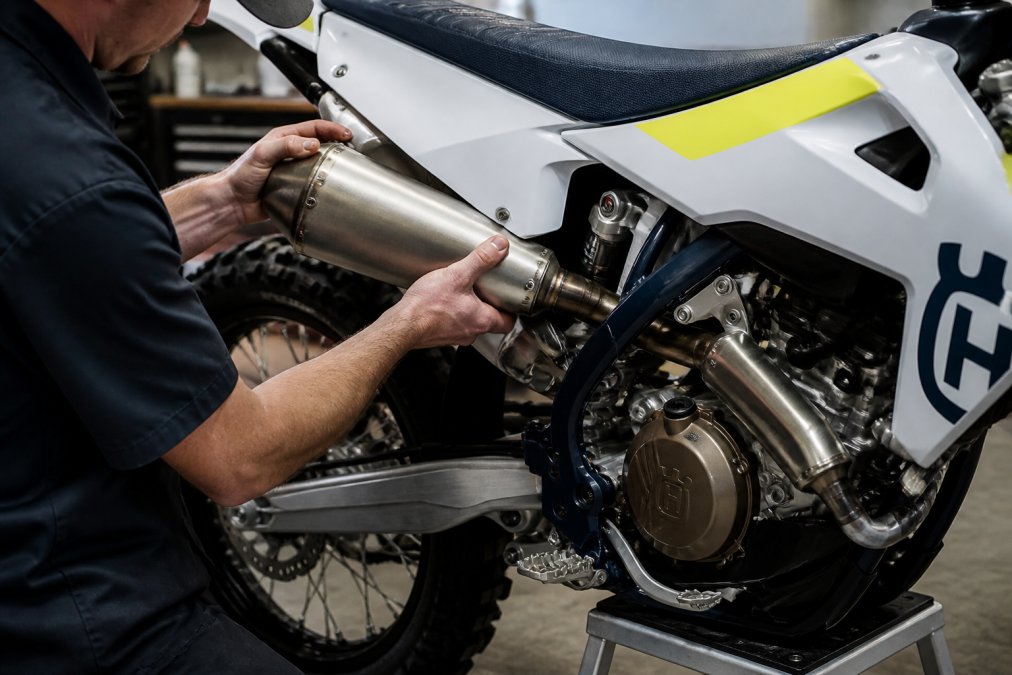
The aftermarket motorcycle exhaust benefits extend far beyond a louder tone, though the sound is what most riders notice first. A performance header and muffler system reduce backpressure, which lowers the temperature inside the cylinder and improves heat dissipation. Cooler combustion chambers allow tuners to advance ignition timing safely, which translates directly into more torque output across the mid-range.
What most guides miss is the weight reduction. Stock exhaust systems on Husqvarna motorcycles carry significant mass high on the chassis. Swapping to a lightweight aftermarket system lowers the center of gravity, which improves handling in corners and reduces rider fatigue over a long day. The combination of less weight and better exhaust flow makes this the single most impactful chassis and engine upgrade available.
The downside is cost and fitment complexity. A quality performance header requires precise alignment, and the heat shielding must be reworked to protect body panels and rider legs. Expect to spend meaningful time on installation, and budget for a fuel controller or ECU reflash to match the increased flow. Without the fuel adjustment, you leave performance on the table and risk a lean condition.
Base Gasket Delete and Cylinder Work for Compression
A base gasket delete is the cheapest way to raise your compression ratio, but it demands precision and mechanical confidence. Removing the cylinder base gasket lowers the cylinder, which reduces the squish clearance between the piston crown and the cylinder head. Tighter squish creates more turbulence in the combustion chamber, improving flame propagation and increasing the effective compression ratio.
The performance gain is immediate: crisper throttle response and a noticeable torque improvement in the low and mid-range. Because the modification costs nothing in parts, it appeals to advanced tuners who have already exhausted exhaust and intake options. The risk, however, is piston-to-head contact if the squish clearance becomes too tight.
Cylinder work pairs naturally with the base gasket delete. Porting the intake manifold and exhaust ports to match your intended RPM range optimizes the power band for your specific use case. A wood-cutting saw benefits from low-end torque, while a racing build wants top-end RPM. The port timing determines where the engine makes power, and grinding the wrong direction ruins a cylinder.
Big Bore Kits and Pop-Up Pistons: Displacement Gains
Big bore cylinder kits deliver the largest displacement gains available for a Husqvanka engine, often increasing cubic capacity by 15 to 20 percent. More displacement means more air and fuel entering the cylinder each revolution, which produces a substantial increase in torque output and cutting speed. These kits replace the stock cylinder and piston with a larger bore, and they require matching the crankcase volume to avoid detonation.
A pop-up piston works alongside the big bore kit to raise the compression ratio without machining the cylinder head. The raised piston crown reduces combustion chamber volume, which increases the compression ratio and improves thermal efficiency. When combined, a big bore kit and pop-up piston transform a stock engine into a serious torque producer that pulls hard through the cut. motocross riding techniques.
The cost and complexity are significant. Big bore kits require engine disassembly, careful measurement of the crankcase and cylinder mating surfaces, and often a carburetor upgrade to supply enough fuel. EPA regulations on small engine emissions restrict certain modifications on equipment used in regulated settings, so verify compliance before you commit to a build that may not be legal for your application.
Husqvarna ECU Tuning Guide: Fuel and Timing Maps
A Husqvarna ECU tuning guide is essential reading for anyone modifying a modern fuel-injected model, because the stock mapping is calibrated for stock hardware. The factory ECU controls the fuel mixture and ignition timing across the entire RPM range, and it compensates for minor changes in air density and temperature. But when you install a performance exhaust or intake system, the stock map leaves the engine running lean at wide-open throttle.
The tuning process involves adjusting the fuel and timing maps to match your modified hardware. A richer mixture at high RPM prevents overheating and protects the piston, while advancing the timing in the mid-range extracts additional torque output. Most tuners use a power commander or a reflash service that rewrites the stock ECU calibration.
Professional calibration matters here. A poorly tuned ECU causes detonation, which destroys pistons and bearings in short order. Professional calibration matters here. A poorly tuned ECU causes detonation, which destroys pistons and bearings in short order. Certified technicians can dial in race-spec Husqvarna motorcycles to rider specifications, ensuring the fuel and timing maps are correct for your exact combination of modifications.
Air Filtration and Carburetor Tuning: Engine Breathing
Air filtration is the intake half of the engine breathing equation, and it is the most neglected part of a performance build. A stock air filter cover restricts airflow to reduce noise and keep debris out, but it also strangles the engine. High-flow air filter systems replace the restrictive element and cover with a design that flows more air while still protecting the engine from dust and dirt.
The danger is over-filtering or under-filtering. Too much airflow without adequate filtration sucks fine dust into the cylinder, which wears the piston rings and cylinder wall rapidly. Quality aftermarket filters use multiple layers of foam or oiled cotton to balance flow with protection, and they require regular cleaning to maintain their performance.
Carburetor tuning completes the breathing picture. After any exhaust, intake, or compression modification, the fuel mixture must be adjusted to match the new airflow. The tuning needles control the mixture at idle, mid-range, and wide-open throttle, and each circuit requires separate adjustment. A proper tune starts rich and leans out gradually while monitoring the spark plug color and cylinder temperature.
Professional Motorcycle Suspension Tuning for the Chassis
Professional motorcycle suspension tuning is the upgrade that makes all your engine work usable, because power is worthless if the chassis cannot translate it into forward motion. A stock suspension setup is a compromise calibrated for an average rider weight and riding style. Professional tuning adjusts the spring rate, compression damping, and rebound damping to match your weight, riding position, and the terrain you ride.
The gains are dramatic. Proper suspension keeps the tires planted through rough sections, which improves traction and allows you to carry more speed into corners. It also reduces rider fatigue by absorbing impacts rather than transferring them to your arms and legs. Most riders notice the difference within the first few minutes of riding a properly tuned machine.
The process requires specialized knowledge and tools. Measuring sag, setting the static and race sag, and adjusting the damping clickers are tasks that benefit from professional experience. Motorcycle Safety Foundation rider training resources emphasize the importance of a properly set up machine for both performance and safety. A certified technician can evaluate your riding style and set up the suspension to match.
| Upgrade | Difficulty | Cost Range | Performance Gain | Best For |
|---|---|---|---|---|
| Muffler Mod | Easy | Low | High | First-time builders |
| Exhaust System | Moderate | High | High | Riders wanting weight reduction |
| Base Gasket Delete | Advanced | Free | Medium | Experienced tuners |
| Big Bore Kit | Advanced | High | Very High | Maximum displacement |
| ECU Tuning | Moderate | Medium | High | Fuel-injected models |
| Air Filter + Carb Tune | Moderate | Low | Medium | All modified engines |
| Suspension Tuning | Professional | Medium | High | Chassis performance |
Choosing Your Upgrade Path
The best Husqvarna performance upgrades follow a logical sequence that respects the engine's design limits. Start with the muffler mod and air filtration to improve engine breathing, then retune the carburetor or ECU to match. If you want more, move to the base gasket delete and cylinder work, and only then consider a big bore kit with a pop-up piston. Skip the order and you risk a lean condition, detonation, and a destroyed engine.
The reliability impact of these modifications depends entirely on the quality of the installation and tuning. A properly executed build with correct fuel mixture and squish clearance runs reliably for years. A rushed build with incorrect clearances fails within hours. When in doubt, consult a professional who has built these engines before.
Emissions and legal compliance matter too. Modifications that remove the spark arrestor or alter the engine's emissions characteristics may violate regulations in your area. Check local laws before you start cutting, and keep your stock parts for situations where compliance is required.
Frequently Asked Questions
What are the best performance upgrades for a Husqvarna dirt bike?
The most effective Husqvarna performance upgrades start with improving engine breathing. A muffler mod or aftermarket exhaust system increases exhaust flow, while a high-flow air filter and proper carburetor tuning ensure the engine gets the right fuel mixture. For bigger gains, consider a big bore kit or a base gasket delete to raise compression. These modifications deliver noticeable gains in cutting speed and throttle response, especially when combined.
Does upgrading the exhaust system improve Husqvarna performance?
Yes. An aftermarket exhaust system reduces backpressure and improves exhaust flow, which allows the two-stroke engine to rev higher and produce more power. This leads to increased torque output and better throttle response. Aftermarket exhaust benefits also include weight reduction and improved heat dissipation. Remember that any exhaust change requires a carburetor retune to prevent a lean fuel mixture, which can damage the engine.
Are ECU remapping services worth the investment for Husqvarna?
For modern fuel-injected Husqvarna models, an ECU tune is one of the most impactful Husqvarna performance upgrades you can make. A professional remap optimizes fuel and ignition timing maps for your specific setup, especially after installing an exhaust or air filter. This can unlock significant horsepower and improve throttle response. It also allows you to adjust for elevation changes, ensuring consistent performance. Check if your model supports this modification.
What is the difference between OEM and aftermarket performance parts?
OEM (Original Equipment Manufacturer) parts are made to the exact factory specification, ensuring a perfect fit and reliable performance. Aftermarket performance parts are designed by third-party companies to exceed stock performance. They often use higher-grade materials or revised designs to boost power, reduce weight, or improve durability. While aftermarket parts can offer significant gains, they may require more mechanical expertise for installation and can affect your factory warranty.
How can I increase the horsepower of my Husqvarna motorcycle?
The most reliable path to more horsepower involves a combination of modifications that improve engine breathing. Start with a performance exhaust and a high-flow air filter to let the engine inhale and exhale more freely. Follow this with a carburetor or ECU tune to optimize the fuel mixture. For substantial gains, explore a big bore cylinder kit. The key is to ensure all modifications work together for a balanced, reliable build.
Choosing the right upgrades for your Husqvarna comes down to your skill level, budget, and intended use. For riders who want professional results without the guesswork, Monarch Powersports offers certified technician calibration and access to elite performance platforms. Our team can dial in your machine to your exact specifications, and our private circuit lets you test the results firsthand. Schedule a test ride and experience the difference that professional setup makes.